
Updated November 3, 2026
Quick answers
- Most failures start in a few spots: flashing, valleys, flat roof seams, chimneys and the roof edge.
- If I had to pick one spot where most leaks start, it's flashing at chimneys, walls, vents and skylights.
- Flat rowhome roofs fail at seams and drains, not evenly across the whole surface.
- You can check most of this with binoculars after a storm and a flashlight in the attic, no ladder needed.
Why Baltimore Roofs Fail, and What to Watch For
Most roof failures we see in Baltimore aren't mysterious. They start in a handful of spots that are easy to miss from the street: flashing, valleys, flat roof seams, chimneys, and the roof edge where gutters overflow. Our weather doesn't help. Summer storms, humid stretches, and freeze-thaw swings in winter all work on the same weak spots year after year.
Here are the risks we run into most, what to look for, and what usually fixes them.
Rowhome roofs and shared walls
On city rowhomes, roofs and walls are tied together. A problem on your neighbor's roof or at the seam between houses can show up on your side.
- Look for: damp or bubbled drywall near the party wall, peeling paint where the homes meet, stains on the upstairs ceiling after a hard rain
- What fixes it: sealing the seam between roofs properly, repointing open mortar joints at the parapet, and sometimes adding a small diverter so water doesn't run toward the joint
Flat roofs on rowhomes also fail at seams and drains, not evenly across the whole surface. A clogged drain or scupper lets water sit, and standing water finds every weak seam.
Slate on older homes
Slate is common on older houses in places like Roland Park, Homeland, and Bolton Hill. It can last a very long time, but freeze-thaw cycles crack individual pieces, and old nails rust out and let slates slide.
- Look for: chipped edges, cracked or missing slates, pieces of slate on the ground or in the gutter
- What fixes it: replacing the broken pieces with matching slate and fixing any flashing nearby. Please don't walk on a slate roof yourself. It's slippery and it breaks under your feet.
Valleys, trees, and clogged gutters
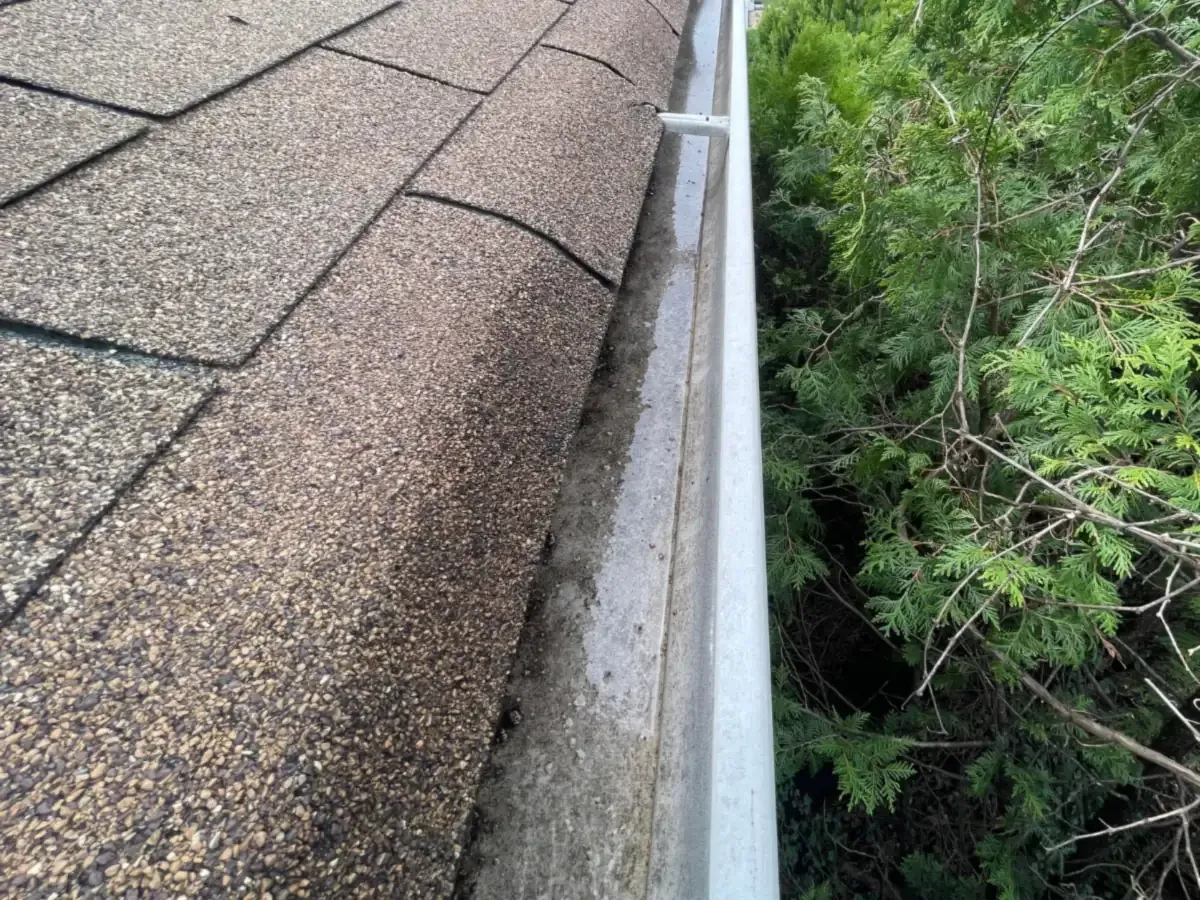
Valleys are where two roof slopes meet, and they carry a lot of water. Leaves, pine needles, and shingle grit pile up there and hold water against the roof.
- Look for: debris sitting in the valleys, stains under the eaves, moss or green streaks near overhanging trees
- What fixes it: clearing the valleys and gutters, trimming branches back from the roof, and repairing any soft spots at the edge
Our gutter cleaning and maintenance page covers the gutter side of this.
Flashing and the chimney joint
If I had to pick one spot where most leaks start, it's flashing. That's the metal at chimneys, walls, vents, and skylights. The shingles can look fine while the metal next to them has rusted, bent, or pulled loose. The joint where the chimney meets the roof is one of the worst for it.
- Look for: rust streaks, bent or missing metal, cracked caulk, and stains near the fireplace or chimney chase inside
- What fixes it: resetting or replacing the flashing, and repointing the chimney if the mortar is part of the problem. Caulk helps, but it's a maintenance item that needs checking, not a permanent fix.
More on that on our roof flashing repair page.
Ice dams at the roof edge
In late winter, snow melts on the roof, runs down, and refreezes at the cold edge. That ice can push water back under the shingles at the eaves, and full gutters make it worse.
- Look for: big icicles on the gutters, ice built up along the roof edge, or wet spots on ceilings along outside walls after a thaw
- What fixes it: repairing the damaged edge, adding ice and water shield there during the repair, and keeping the gutters clear so meltwater can drain
What you can check yourself
You don't need a ladder for most of this. Grab a pair of binoculars and walk around the house after a big storm. Then take a look in the attic with a flashlight. Small leaks that sit for a year turn into soft wood and a bigger repair, so it's worth catching them early. For how we track down where a leak is actually coming in, see our roof leak detection and repair page.
If you're not sure what you're looking at, text your address and a few pictures to 443-900-4815 or give us a call. I'm licensed and insured, MHIC #154344.
| Spot | Look for | What fixes it |
|---|---|---|
| Rowhome party wall | Damp drywall near the shared wall | Seal the seam, repoint the parapet |
| Slate | Cracked, missing or fallen pieces | Matching slate, nearby flashing |
| Valleys and gutters | Debris, stains under the eaves | Clear them, trim branches |
| Flashing | Rust, bent metal, cracked caulk | Reset or replace flashing |
| Roof edge in winter | Ice along the edge | Repair the edge, ice and water shield |
About the author
James Preston runs Omni-Roof. I'm licensed and insured, MHIC #154344, with 24+ years of roofing and work on thousands of Baltimore homes. We're BBB accredited, A+, and I'm an FAA-licensed drone pilot. More about us.